Research & Reports
Playbook: How Food & Beverage Leaders Can Master Continuous Change
1 minute read

3 minute read
Most M&A deals fail to deliver their expected value, often because integration efforts lack structure, visibility, and accountability.
An Integration Management Office (IMO) provides the governance, coordination, and execution needed to keep integration activities on track and accelerate synergy realization.
An IMO delivers:
By aligning teams, managing dependencies, and maintaining focus on business objectives, an IMO helps organizations turn M&A strategy into measurable results.
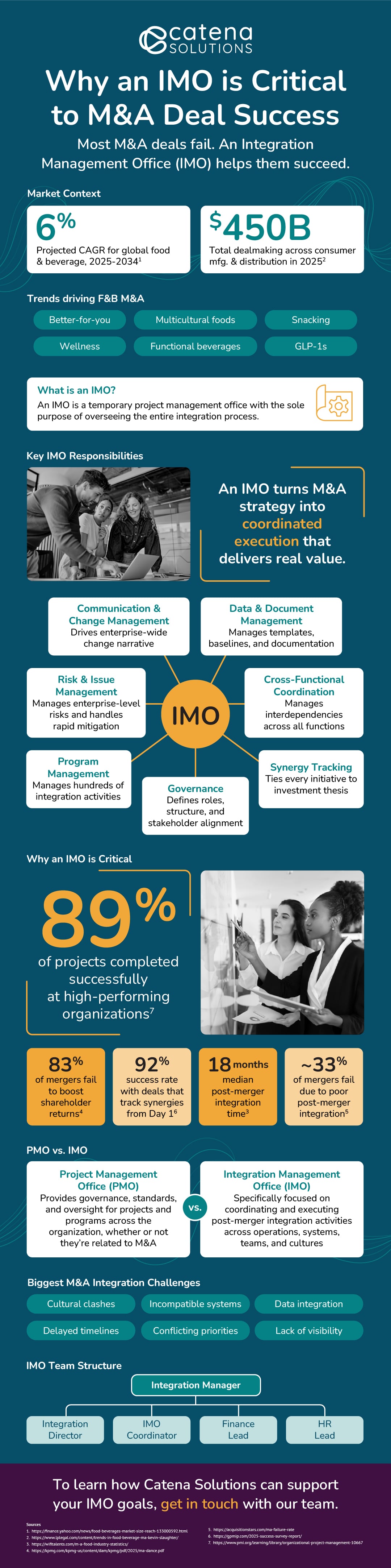
Most mergers and acquisitions (M&A) deals fail to achieve their intended objectives. An Integration Management Office (IMO) helps organizations navigate the complexities of post-merger integration, coordinate activities, and realize deal value.
The food and beverage industry continues to experience significant M&A activity, driven by changing consumer preferences and opportunities for growth.
An Integration Management Office (IMO) is a temporary project management office with the sole purpose of overseeing the entire integration process.
An IMO turns M&A strategy into coordinated execution that delivers real value.
An IMO manages six core areas of post-merger integration:
The IMO also supports enterprise-level risk and issue management, including rapid mitigation of emerging risks.
Effective project management and integration oversight can help organizations achieve their strategic objectives.
Key statistics highlighted in the infographic include:
These statistics emphasize the importance of structured integration planning, governance, and synergy tracking.
Although both offices provide project oversight, they serve different purposes.
A PMO provides governance, standards, and oversight for projects and programs across the organization, whether or not they are related to M&A.
An IMO specifically focuses on coordinating and executing post-merger integration activities across operations, systems, teams, and cultures.
The primary distinction is that a PMO supports broader organizational project management, while an IMO is dedicated to successful M&A integration.
Organizations commonly encounter six challenges during the integration process:
An IMO helps organizations address these challenges through coordinated planning, communication, governance, and execution.
The infographic illustrates a typical IMO team structure with an Integration Manager overseeing four key roles:
This structure supports cross-functional coordination and accountability throughout the integration process.
Catena Solutions helps organizations coordinate post-merger integration activities, align stakeholders, manage risks, and execute integration strategies.
To learn how Catena Solutions can support your IMO goals, get in touch with our team.