Articles & Perspectives
What Sanitation Gaps Raise Recall Risk in Food Plants
6 minute read

4 minute read
Sanitation gaps in food and beverage manufacturing stem from a set of six common causes. These include inadequate frontline training, a production-first culture, organizational silos, poor documentation, unvalidated Clean-in-Place (CIP) systems, supplier misalignment, and limited visibility into sanitation performance data. Left unaddressed, any one of these issues increases the risk of recalls, audit failures, regulatory action, and foodborne illness.
The stakes are high for sanitation failures. The CDC estimates that each year, 48 million Americans get sick from foodborne illness, with 128,000 hospitalized and 3,000 dying. A 20-year study also found that biological contamination and allergens account for roughly 76% of food and beverage recalls.
Keep reading for the six causes of sanitation gaps we see most often and how to help close them.
When organizations view sanitation training as a requirement instead of an activity that needs continuous attention, the results show up on the floor. Employees follow directions inconsistently, miss critical steps, or fail to recognize risks, even when proper procedures are laid out in front of them.
Effective manufacturers build training into daily operations through regular coaching, refresher sessions, visual management systems, and competency assessments. When frontline employees understand the direct connection between their actions and food safety outcomes, compliance can become a standard practice instead of a reactive response.
A global food safety training survey found that nearly three-quarters of respondents said employees were not consistently following established protocols despite receiving training.
Related Case Study: Bringing Consistency and Ownership to a Sanitation Program

Production metrics are visible, tracked, and tied directly to revenue. Food safety risks, however, stay invisible until a contamination, audit finding, or recall makes them impossible to ignore.
This dynamic creates pressure to keep lines running, delay sanitation activities, or push past warning signs of major issues. Organizations with strong sanitation performance counter this by making food safety non-negotiable at every level. They teach their employees, from leadership to the frontline, that stopping production to address a sanitation concern is the right call, even if it impacts the bottom line.
Among consumers who report low confidence in U.S. food safety, 59% believe that profit is prioritized over safety.
Sanitation doesn’t belong to a single department. Effective programs require coordination across Quality, Food Safety, Operations, Engineering, Maintenance, and Leadership. When departments operate in isolation, sanitation issues fall into the gaps and problems go unaddressed.
Leadership must play an active role in breaking down these silos. The most resilient companies create shared accountability for sanitation outcomes and keep food safety top of mind during operational decisions.
Catena helped a meat processor transition from an outsourced sanitation model to an internally managed program, strengthening accountability, increasing stakeholder engagement, and improving visibility into operational risk.
Related Case Study: Establishing a Quality Assurance Model Across a Global Manufacturing Network
You can’t argue with documentation. Proper documentation proves that sanitation procedures were completed correctly and consistently. Without it, organizations face audit risk, a limited ability to find abnormalities, and no way to show improvement.
Regulators and auditors don’t just ask whether sanitation activities happened, they want proof around what specifically happened. Strong documentation systems create traceability, support compliance, and reinforce continuous improvement efforts.
According to a 2025 global food safety training survey, more than half of food safety professionals still rely on paper-based systems to manage training records, while 27% use spreadsheets.
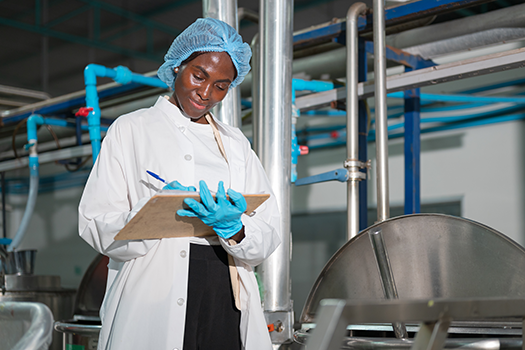
A CIP system can be a major source of sanitation compliance risk.
Many facilities assume their systems are functioning properly because they were designed by equipment suppliers or have run for years without obvious issues. However, that type of thinking is risky. Improper flow rates, inadequate chemical concentrations, poor circuit design, and uncalibrated sensors can go undetected for a long time.
Without proper validation, facilities may unknowingly experience ineffective cleaning, product loss, contamination, and recurring sanitation failures. Every CIP circuit should be validated under operating conditions to confirm it consistently performs as it should.
In one engagement, Catena helped a dairy and meat processor redesign and optimize its CIP program, resulting in a 90% reduction in product waste and approximately $700,000 in annual sanitation cost savings.
Related Case Study: Sanitation System Overhaul for a New Production Plant
Food safety risk extends far beyond the manufacturing facility.
Suppliers, co-manufacturers, co-packers, and contract production partners all influence sanitation performance. When external partners operate under different standards or lack sufficient controls, the risk transfers directly to the brand owner.
This challenge tends to intensify after mergers and acquisitions, when newly integrated facilities or supplier networks may not align with existing food safety expectations. Organizations need clear sanitation requirements, supplier qualification standards, audit programs, and ongoing performance monitoring across their full manufacturing network.
A fast-growing dessert company was acquired by a global food conglomerate and needed urgent FSQ upgrades to meet the parent company’s standards. Catena Solutions helped the organization achieve 99% conformance by assessing partners, closing compliance gaps, and building a durable quality program.
None of these root causes are unfixable. With the right expertise and a commitment to lasting change, organizations can identify where their sanitation programs are most vulnerable and build programs that are compliant and resilient.
Catena Solutions works alongside food and beverage teams to diagnose the root causes of compliance gaps and develop solutions that last. Contact our team for more information.